


In 2026, choosing the wrong GPU for your dedicated server isn't just a technical mistake it's a budget mistake. Renting an H100 for a workload that never saturates its compute is money burned every single hour. Renting an A100 for a 70B-parameter training job you need finished by Friday is a deadline missed. The right choice depends entirely on what you're actually running, not which GPU sounds more impressive on a spec sheet.
This guide breaks down the real differences between the NVIDIA H100 and A100 architecture, memory bandwidth, multi-GPU scaling, and price-per-throughput so you can match the hardware to the workload instead of guessing.
Quick answer: If you're training large models (70B+ parameters), running FP8 inference at scale, or need maximum tokens-per-second for production LLM serving, the H100 wins on total cost despite the higher hourly rate. If you're fine-tuning smaller models with LoRA/QLoRA, running inference on models that can't saturate an H100's throughput, or working with a tighter budget, the A100 remains the smarter rental in 2026.
H100 vs A100: Full Specification Comparison
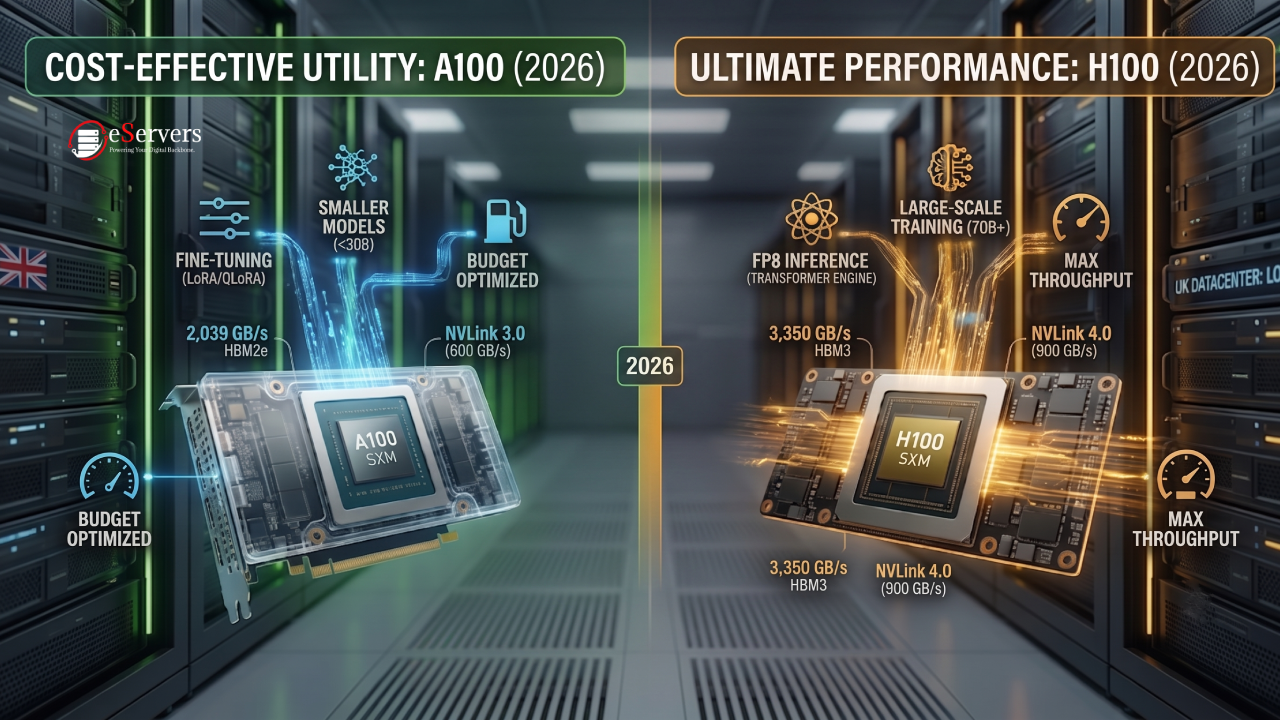
| Spec | NVIDIA A100 | NVIDIA H100 |
|---|---|---|
| Architecture | Ampere (2020) | Hopper (2022) |
| VRAM | 40GB / 80GB (HBM2e) | 80GB (HBM3 on SXM) |
| Memory Bandwidth | ~2,039 GB/s | ~3,350 GB/s (SXM) |
| NVLink | NVLink 3.0 — 600 GB/s | NVLink 4.0 — 900 GB/s |
| Precision Support | FP16, BF16, TF32 | FP16, BF16, TF32, FP8 (Transformer Engine) |
| MIG Partitioning | Up to 7 instances | Up to 7 instances |
| Best Suited For | Fine-tuning, mid-size training, cost-sensitive inference | Large-scale training, high-throughput inference, FP8 workloads |
Architecture: Ampere vs Hopper
The A100 runs on NVIDIA's Ampere architecture and was the industry-standard training GPU from 2020 through 2023. It introduced third-generation Tensor Cores and Multi-Instance GPU (MIG) partitioning, allowing a single card to be split into up to seven isolated instances a feature that made it practical for multi-tenant serving and shared development environments. On the A100 80GB, each of the seven MIG instances gets approximately 10 GB of dedicated HBM2e, making it practical for multi-tenant serving or inference deployments where a 10 GB slice covers the model.
The H100 moved to the Hopper architecture and introduced the Transformer Engine a mechanism that automatically switches between FP8 and FP16 precision layer-by-layer during training and inference. For transformer-based models, this delivers roughly 3-4x the throughput of the A100 at FP16, with the engine automatically adjusting precision to maintain accuracy without manual tuning. This is the single biggest reason the H100 dominates large language model workloads today.
Memory Bandwidth: Where the Real Speed Difference Lives
Both GPUs ship with 80GB of VRAM at the top end, which surprises a lot of buyers who assume the H100 simply has "more memory." Both GPUs have 80 GB of HBM the H100 uses HBM3 at roughly 3,350 GB/s while the A100 uses HBM2e at roughly 2,039 GB/s, a 1.64x bandwidth difference that is the primary driver of the H100's inference speedup on memory-bound operations.
That bandwidth gap matters most during LLM inference, where the decode phase requires reading the entire model weight tensor for every generated token so the faster the memory, the faster the tokens come out. For workloads that aren't memory-bandwidth bound (smaller models, lower concurrency), that advantage shrinks considerably.
NVLink and Multi-GPU Scaling
If your workload spans multiple GPUs which almost any serious training job does interconnect speed determines how efficiently those cards work together. The A100 uses NVLink 3.0 with 12 links at 50 GB/s each for 600 GB/s total bidirectional bandwidth, while the H100 uses NVLink 4.0 with 18 links at 50 GB/s each for 900 GB/s total.
On an 8-GPU cluster training a 70B+ model, that 50% bandwidth increase directly reduces the time GPUs spend idle waiting on gradient synchronisation.
FP8: The A100's Hard Ceiling
This is the point most comparison articles bury, and it shouldn't be buried: the A100 cannot run FP8. If your inference pipeline is built around FP8 quantisation for maximum throughput, the A100 is not an option full stop, regardless of price. High-throughput serving where latency and tokens-per-second drive cost, and anything memory-bandwidth bound that benefits from HBM3, are scenarios where the H100 should be the default pick.
Price-Per-Throughput, Not Price-Per-Hour
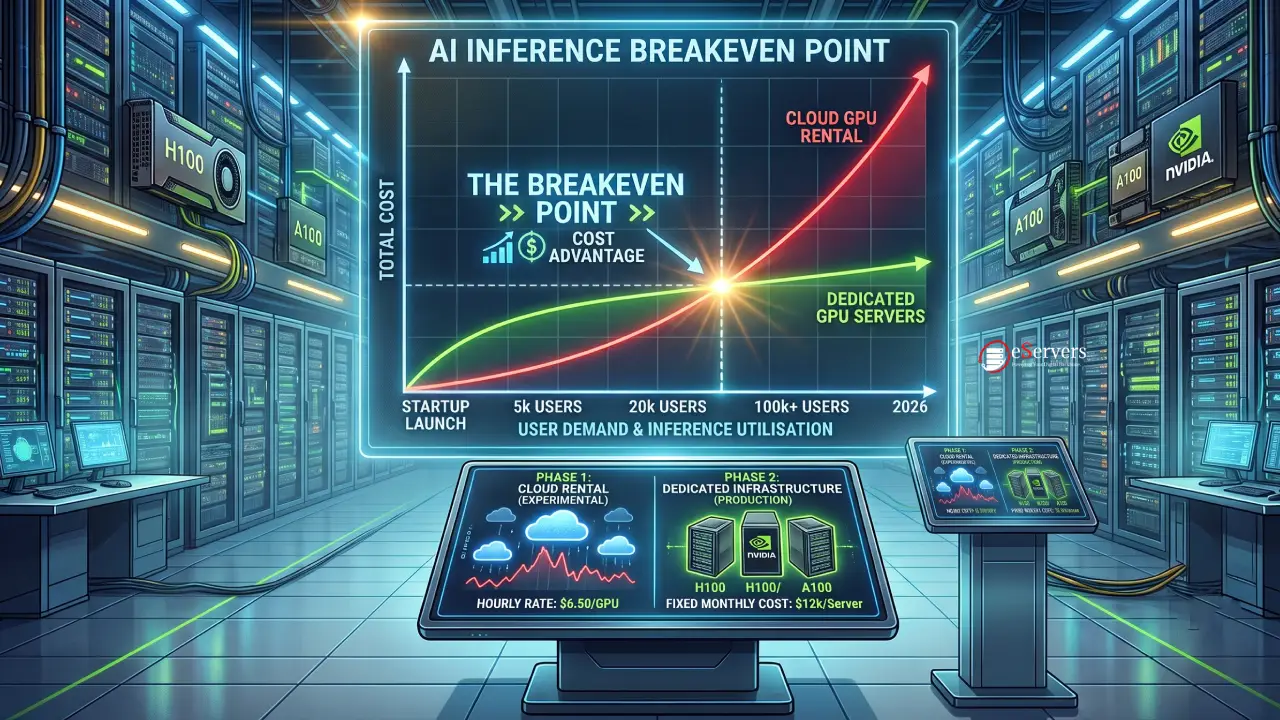
The mistake most UK businesses make when comparing GPU dedicated servers is looking at the hourly or monthly rental price in isolation. The correct comparison is price-per-throughput: if your workload gets the full H100 speedup, the H100 usually wins on total cost if it doesn't, the A100 wins.
A practical rule of thumb from current 2026 GPU rental analysis: a good test is whether you can actually keep the H100 busy if you can't, you probably don't need it yet.
When the H100 Is the Right Call
Training models with 70B+ parameters, where compounding time savings offset the higher hourly cost.
FP8 inference at scale a capability the A100 simply doesn't have.
High-concurrency production LLM serving where tokens-per-second directly drives revenue.
Any workload that is bandwidth-bound and benefits from HBM3's throughput.
When the A100 Is the Smarter Rental
Budget training of models up to roughly 30B parameters at FP16, fine-tuning with LoRA or QLoRA where VRAM and cost matter more than peak speed, inference on smaller models that can't saturate an H100, and cost-sensitive experimentation or academic work are all scenarios where the A100 remains the better financial decision in 2026 it is far from obsolete.
GPU Dedicated Servers in the UK: What to Actually Look For
Renting an H100 or A100 through a UK-based dedicated server provider (rather than a US hyperscaler) solves two problems that pure cloud GPU rental doesn't: data residency under UK GDPR, and egress costs, which on major clouds can quietly double your monthly bill once you start moving trained models or inference outputs off the platform.
When evaluating a UK GPU dedicated server provider, the technical checklist should include:
Deployment locations proximity to your team or user base reduces latency for interactive inference and remote training management.
Network backbone the carriers your traffic actually routes through determine real-world throughput to your users, not just the advertised port speed.
Fully customisable OS and control panel access GPU workloads often need specific CUDA/driver versions, and locked-down environments slow you down.
On-demand availability GPU stock has been tight industry-wide; a provider with deployable inventory beats one with a long lead time.
Transparent, flat pricing no surprise egress fees when you export checkpoints or serve inference traffic.
eServers' GPU-enhanced server range is built around exactly this: deployment across UK hubs including London, Coventry, and Maidenhead, routed through carrier partners including RETN, NTT, Lumen, Zayo, Colt, EXA, and M247, with fully customisable, on-demand configurations. For exact current H100 and A100 configuration pricing, check the live GPU servers page, as availability and pricing shift with GPU stock.
Common Use Cases by GPU
Artificial Intelligence & Machine Learning model training, fine-tuning, and production inference pipelines, where the H100/A100 decision above directly applies.
3D Rendering & VFX batch rendering and simulation workloads that benefit from raw compute and VRAM capacity more than FP8 precision gains.
Scientific & High-Performance Computing (HPC) simulation-heavy workloads where NVLink bandwidth and double-precision throughput matter as much as AI-specific features.
The Bottom Line
The H100 vs A100 decision in 2026 isn't about which GPU is "better" in the abstract it's about whether your specific workload can actually use what the H100 offers. Compute-bound, large-scale, FP8-capable pipelines justify the H100's premium many times over. Everything smaller, lighter, or more budget-constrained is usually served better and cheaper by the A100.
Match the GPU to the job, not the job to the GPU.
H100 vs A100 UK Dedicated Server FAQ
Which NVIDIA GPU is right for me?
If your workload trains large models, needs FP8 inference, or serves high-concurrency production traffic, choose the H100. If you're fine-tuning smaller models, running inference that won't saturate an H100, or working within a tighter budget, the A100 delivers better value per pound spent.
Can I install a custom operating system on a GPU dedicated server?
Yes on a properly configured bare-metal GPU server you retain full root access to install your preferred OS, CUDA version, and ML framework stack rather than being locked into a fixed image.
Are these GPU servers actually located in the UK?
Yes, provided you confirm the specific data centre location with your provider UK-based deployment keeps your data under UK GDPR jurisdiction and reduces latency for UK-based users, unlike renting from US or EU-based cloud regions.
Is the H100 always faster than the A100?
Not in every scenario. Below a certain batch size or concurrency, workloads become memory-bandwidth-bound rather than compute-bound, and the H100's advantage narrows significantly. For small, low-concurrency jobs, the gap is often not worth the price premium.
Do I need multiple GPUs for LLM training?
For any model above roughly 30B parameters at full precision, yes a single 80GB card (H100 or A100) can't hold the weights, so you'll either quantise or scale across multiple GPUs, where NVLink bandwidth becomes the deciding factor between the two cards.