


Estimated reading time: 10 minutes
Best for: AI founders, CTOs, Machine Learning Engineers, DevOps teams, and infrastructure managers planning production AI workloads.
The AI Infrastructure Bill That Grows With Success
Most AI startups make the same infrastructure decision early in their journey: rent GPU capacity.
It makes sense. During experimentation, prototyping, and early model development, cloud GPU rental provides exactly what teams need:
Immediate access to powerful NVIDIA GPUs
No upfront hardware investment
Flexible scaling
No responsibility for hardware maintenance
For a startup testing ideas or training occasional models, hourly GPU rental is usually the right choice. The challenge appears later.
When an AI product gains real users, inference becomes a permanent operational cost. Every chatbot request, image generation task, recommendation query, or AI-powered workflow consumes GPU resources. The uncomfortable reality is that GPU costs often increase at exactly the moment a startup is succeeding.
More users create more revenue, but they also create more inference demand. At some point, many teams discover they are no longer paying for occasional GPU access — they are paying continuously for infrastructure that behaves like a permanent production system. That is where the economics of GPU rental begin to change.
Why AI Inference Costs Become the Real Infrastructure Challenge
Training and inference have completely different cost profiles.
Training is usually a planned event. A company trains or fine-tunes a model, completes the process, and moves into deployment.
Inference is different. Inference continues every day for as long as customers use the product. A production AI application may require GPUs running continuously to support:
Large language model responses
Image generation
Voice processing
Recommendation engines
Document analysis
AI agents
Custom machine learning workflows
The question is no longer: "How much does it cost to train this model?"
The better question becomes: "How much does every customer interaction cost over the lifetime of the product?"
Training vs Inference: Two Different Cost Problems
| Factor | Training | Inference |
|---|---|---|
| Cost pattern | Large, occasional investment | Continuous operational expense |
| Duration | Usually limited | Runs throughout product lifetime |
| Main challenge | Completing the training efficiently | Controlling cost per request |
| Scaling factor | Model complexity | User demand |
| Common mistake | Underestimating compute requirements | Never reviewing infrastructure economics |
Many AI startups optimise their models but never revisit their infrastructure model. A workload that made sense on rented GPUs during development may become unnecessarily expensive when running 24/7 production inference.
Why Hourly GPU Rental Works at the Beginning
Cloud GPU rental exists for a good reason. It solves an important problem: access.
A startup can launch an AI product without purchasing expensive hardware such as:
NVIDIA H100 GPUs
NVIDIA A100 GPUs
NVIDIA L40S GPUs
This flexibility is valuable when demand is uncertain. A company building a prototype may only need GPUs for a few hours per day. A research team may need additional capacity during experiments. A startup testing multiple models may not know what hardware configuration will work best.
In these situations, paying hourly is efficient because the GPUs are being used only when needed. The problem starts when temporary infrastructure becomes permanent infrastructure.
The Utilisation Question That Determines Your Best Option
The biggest factor in GPU economics is not the GPU model. It is utilisation. How continuously is the hardware being used?
Low utilisation
Example: A startup runs experiments occasionally and has unpredictable workloads.
Cloud GPU rental is usually the best option. Buying hardware would mean paying for expensive equipment that sits unused.
Medium utilisation
Example: An AI company has regular production traffic but still experiences unpredictable demand.
Reserved capacity or committed-use GPU contracts may provide better economics. This reduces rental costs without requiring full hardware ownership.
High utilisation
Example: An AI application serves customers continuously and GPUs operate most of the day.
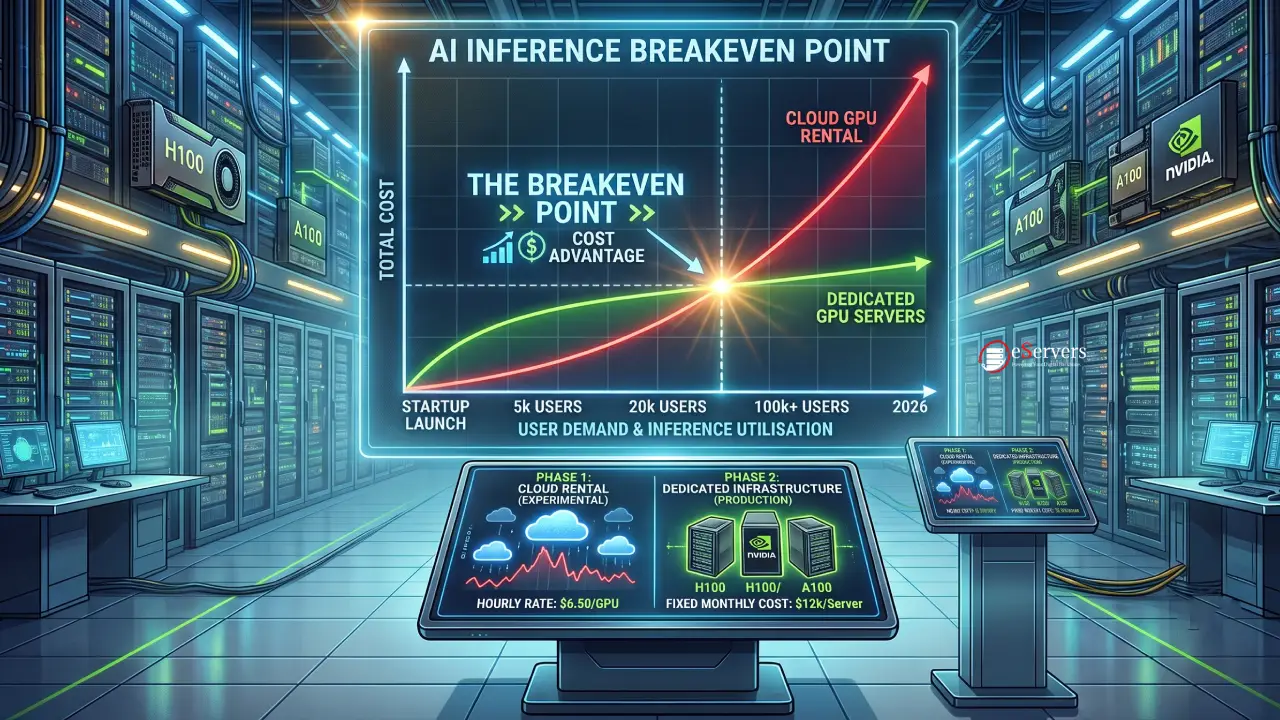
At this stage, dedicated GPU infrastructure often becomes financially attractive. The company is effectively renting the same resource repeatedly, paying an hourly premium for something it already needs permanently.
Calculating Your GPU Breakeven Point
Instead of guessing whether buying or renting is better, companies should model their own numbers. A simple calculation:
Breakeven utilisation = Cost of owned or reserved GPU infrastructure over a period ÷ (Hourly GPU rental cost × total available hours)
If actual utilisation is consistently above this point, dedicated infrastructure may provide better long-term economics.
For example: A startup using GPUs almost continuously for customer requests has a very different cost profile from a research team using GPUs occasionally. The same hardware can have completely different financial outcomes depending on utilisation.
Cloud GPU Rental vs Dedicated GPU Infrastructure
| Factor | Cloud GPU Rental | Dedicated GPU Infrastructure |
|---|---|---|
| Initial setup | Very fast | Requires planning |
| Upfront investment | Low | Higher |
| Scaling | Immediate | Add additional hardware |
| Cost model | Variable hourly cost | Predictable monthly cost |
| Best for | Testing and unpredictable workloads | Continuous production workloads |
| Hardware control | Limited | Complete |
| Data control | Provider dependent | Fully controlled |
| Long-term cost predictability | Lower | Higher |
There is no universal winner. The correct choice depends on workload behaviour, engineering capability, and business requirements.
Why Dedicated GPU Servers Change AI Economics
Once AI workloads reach consistent utilisation, dedicated GPU servers change the cost model. Instead of paying every hour for shared cloud capacity, businesses move toward predictable infrastructure costs.
Dedicated GPU infrastructure provides:
Full GPU availability
Consistent performance
Direct hardware control
Predictable monthly budgeting
Greater control over data location
For production AI systems, this can significantly improve cost efficiency. A typical production stack may include: NVIDIA GPU hardware, CUDA acceleration, Linux-based infrastructure, Containerised workloads, Kubernetes orchestration, and Model serving platforms such as NVIDIA Triton Inference Server.
The goal is not simply owning hardware. The goal is reducing the cost per inference request while maintaining performance.
Production AI Requires More Than GPUs
A GPU alone does not create a reliable AI platform. Production environments also require:
Model Serving: Tools such as Triton Inference Server help deploy and manage multiple AI models efficiently.
Containerisation: Docker and Kubernetes allow teams to package, scale, and manage AI workloads consistently.
Monitoring: AI infrastructure requires monitoring of GPU utilisation, memory usage, request latency, model performance, and resource availability.
Networking: Low-latency private networking between application servers, databases, and inference nodes improves reliability and performance.
A successful AI platform is an infrastructure ecosystem, not just a powerful GPU.
When You Should Not Buy GPU Hardware
Dedicated GPU infrastructure is not always the right decision. Cloud rental remains the better choice when:
The product is still experimental
Traffic is unpredictable
Models are changing frequently
GPU utilisation is low
The team does not want hardware management responsibilities
Early-stage startups should avoid purchasing expensive hardware simply because a GPU bill feels expensive. The right time to move is when usage data proves that dedicated infrastructure makes financial sense.
Signs Your Startup Has Outgrown GPU Rental
You may be ready to reconsider your infrastructure model if:
GPU costs increase every month alongside user growth
Inference has become one of the largest operating expenses
GPUs run continuously rather than occasionally
Cost per request is becoming difficult to control
You need stronger data residency guarantees
Infrastructure spending is unpredictable
At this stage, a dedicated or hybrid GPU strategy deserves evaluation.
The Hybrid Approach: The Practical Migration Path
Many successful AI companies do not immediately move everything away from cloud platforms. A common approach is:
Phase 1 — Development and Experimentation: Continue using cloud GPUs for model testing, research, and short-term workloads.
Phase 2 — Production Migration: Move predictable workloads onto dedicated GPU servers, reserved GPU capacity, or colocated hardware.
Phase 3 — Hybrid Scaling: Keep burst capacity available for traffic spikes, new product launches, and temporary demand increases.
This approach combines flexibility with cost control.
UK Data Residency and Private AI Infrastructure
For businesses operating in regulated industries, infrastructure location matters. AI systems may process customer data, business documents, internal knowledge bases, proprietary models, and operational information.
Keeping AI infrastructure within UK-based data centres can simplify discussions around data residency, customer compliance requirements, supplier assessments, and security reviews. Dedicated GPU infrastructure combined with private networking provides greater control over where sensitive workloads operate.
Conclusion
GPU rental is not the wrong choice. It is the right choice for uncertainty.
The problem begins when a startup continues using a temporary pricing model for a permanent workload. As AI products mature, inference becomes a continuous infrastructure requirement. At that point, understanding utilisation, calculating breakeven points, and evaluating dedicated GPU infrastructure can significantly improve long-term economics.
The companies that manage AI infrastructure costs effectively are not simply choosing cheaper hardware. They are choosing the right infrastructure model for the stage their business has reached.
Infrastructure Considerations
Production AI workloads typically require more than GPU capacity alone. Growing AI teams often evaluate:
Dedicated GPU servers for predictable inference performance
NVMe storage for model files and high-speed data access
Private networking between application and inference layers
Colocation for owned GPU hardware
Backup solutions for model checkpoints, configurations, and critical data
Choosing infrastructure based on real utilisation patterns allows AI businesses to control costs while maintaining the performance required for modern AI applications.
Frequently Asked Questions (FAQ)
Is renting GPUs cheaper than buying?
It depends on utilisation. Rental is usually cheaper for unpredictable workloads, while dedicated GPU infrastructure often becomes more economical for continuous production workloads.
When should an AI startup move from cloud GPUs to dedicated GPUs?
The right time is when GPU usage becomes predictable and continuous enough that hourly rental costs exceed the benefits of flexibility.
Are dedicated GPU servers better for AI inference?
For high-utilisation production inference, dedicated GPU servers can provide better cost predictability and consistent performance. Cloud GPUs remain useful for flexible workloads.
Which GPUs are commonly used for AI infrastructure?
Common enterprise AI GPUs include NVIDIA H100, A100, and L40S, depending on model size, performance requirements, and budget.
Do AI startups need Kubernetes for GPU workloads?
Not every startup needs Kubernetes immediately, but growing production environments often use Kubernetes or similar orchestration tools to manage scaling, deployment, and resource allocation.
Is GPU colocation a good option?
GPU colocation can be attractive for companies that own hardware but want professional data centre facilities, reliable power, cooling, connectivity, and security.