


The Question Most Businesses Ask Too Late
When businesses choose a hosting location, the conversation is almost always about speed: lower latency for UK visitors, faster page loads, better search rankings. All true, and all good reasons to host in the UK. But there's a second question that gets asked far less often, usually only after a customer, auditor, or regulator raises it first: where, legally, is our data allowed to live?
Server location isn't just an infrastructure decision. For any UK business handling personal data, it's a compliance decision with real legal consequences — and conflating it with a pure performance choice is one of the more expensive mistakes a growing company can make.
UK GDPR, in Plain Terms
Since the UK's departure from the EU, data protection in Britain is governed by the UK GDPR, which sits alongside the Data Protection Act 2018, rather than the EU's GDPR directly. The two frameworks are closely aligned in substance, but they are legally distinct regimes, each enforced by its own regulator and each with its own rules about moving data across borders.
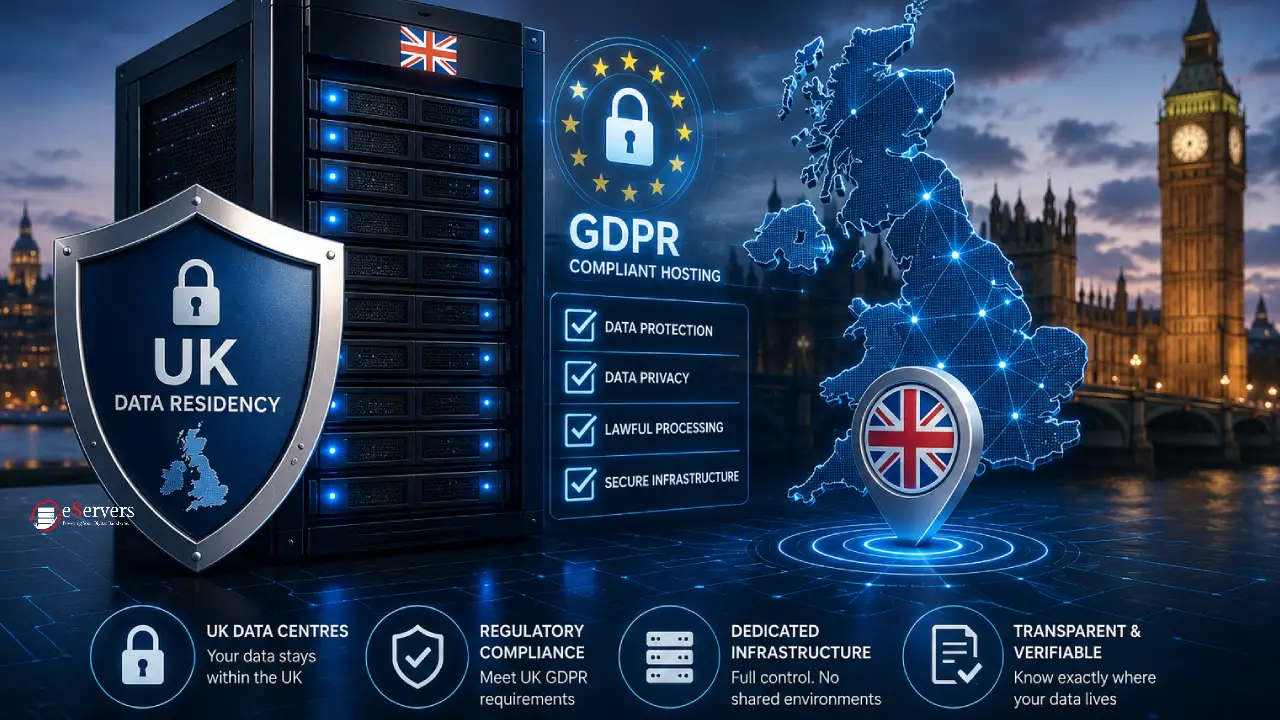
The core principle that matters for hosting decisions is this: if you transfer personal data outside the UK, you need a lawful mechanism to do it — an adequacy decision, standard contractual clauses, or another approved safeguard. The UK currently has an adequacy decision in place covering transfers to the EU/EEA, but transfers to many other jurisdictions, including parts of the US, require additional contractual safeguards that add legal overhead and risk.
Hosting your infrastructure in a UK data centre with a UK-based provider sidesteps this question almost entirely. There's no cross-border transfer to assess, no adequacy mechanism to maintain, no contractual clause to keep current as guidance evolves.
The Misconception: "Hosting in the UK Means I'm Automatically Compliant"
This is the mistake that catches businesses out. Choosing a UK data centre solves one part of GDPR — the data transfer question. It does not, by itself, make a business compliant. GDPR compliance also requires:
A documented lawful basis for processing personal data
Appropriate technical and organisational security measures
A clear data retention and deletion policy
The ability to fulfil data subject access requests
Breach notification procedures, including the 72-hour reporting requirement to the ICO
A UK-hosted server with no firewall, no encryption at rest, and no access logging is still a GDPR liability — it's just no longer a cross-border transfer liability. Location and security posture are separate requirements that both need to be met.
Why This Matters More for Dedicated and Bare-Metal Hosting
On shared cloud platforms, your data often sits on infrastructure spanning multiple regions by default, with replication and failover happening behind the scenes in ways that aren't always transparent to the customer. Finding out exactly which jurisdictions your data touches can require digging through a provider's documentation, and in some architectures the honest answer is "it depends."
A dedicated bare-metal server in a known UK data centre removes that ambiguity. You know precisely which building your data is in, which makes answering a customer's or auditor's data residency question a factual statement rather than an investigation. For businesses in regulated sectors — healthcare, finance, legal services — this clarity isn't a nice-to-have, it's frequently a contractual requirement from clients or insurers.
A Practical Checklist for UK Data Residency
When evaluating whether your hosting setup actually supports your compliance position, a few questions are worth answering directly:
Where is the physical server located, and can the provider confirm this in writing? A UK postal address for the company isn't the same as a UK location for the data centre. Ask for the specific facility.
Does any backup or disaster recovery copy of the data leave the UK? Off-site backups are good practice — but if the off-site location is in another jurisdiction, that's a transfer that needs its own legal basis.
Who has administrative access to the underlying hardware? On a dedicated bare-metal server, you're typically the only tenant, which reduces the number of parties with potential access compared to multi-tenant cloud environments.
Is the data encrypted at rest and in transit? Location compliance and security compliance are both required; one doesn't substitute for the other.
What does the data processing agreement actually say about sub-processors and onward transfers? A clean UK hosting location can still be undermined by a sub-processor clause that allows data to flow elsewhere.
Where This Fits Into a Wider Infrastructure Strategy
Data residency shouldn't be treated as a one-off checkbox during initial setup. It's a standing constraint that should inform every infrastructure decision going forward: which data centre new servers go into, where backups replicate to, which third-party tools get connected, and how disaster recovery is architected. A backup strategy that quietly syncs to an out-of-region object storage bucket can undo the residency position a business spent months establishing.
The practical takeaway is straightforward: treat server location as part of your compliance architecture, not just your performance budget. Choosing UK data centres for both primary infrastructure and backup targets removes an entire category of legal complexity, and it gives a business a simple, defensible answer when a customer or regulator asks where their data actually lives.
eServers operates UK dedicated server and colocation infrastructure across data centres in London, Manchester, Edinburgh, Slough, Portsmouth, and Glasgow — giving businesses a clear, verifiable UK location for both primary hosting and backup targets.
Frequently Asked Questions (FAQ)
Is hosting data in the UK enough to be GDPR compliant?
No. UK hosting removes the cross-border transfer question, but compliance also requires a lawful basis for processing, adequate security measures, breach notification procedures, and proper handling of data subject rights.
Does UK GDPR differ from EU GDPR?
They are separate legal frameworks that are closely aligned in content but enforced independently — the UK GDPR by the Information Commissioner's Office (ICO), and the EU GDPR by relevant EU data protection authorities.
Can a UK business legally use a US-based cloud provider?
Yes, but it typically requires additional legal safeguards, such as standard contractual clauses, to make the transfer lawful, and the compliance burden of maintaining those safeguards falls on the data controller.
Is dedicated server hosting more compliant than cloud hosting?
Neither approach is automatically more compliant — what matters is the actual location of the infrastructure, the security controls in place, and the contractual terms with the provider. Dedicated hosting does typically offer clearer visibility into exactly where data sits.