


Where Every Game Hosting Business Starts
Almost every successful game server hosting business starts in the same place: a small VPS. It's affordable, easy to deploy, and gives new hosting providers enough resources to launch their first Minecraft community, FiveM roleplay server, Rust environment, or ARK: Survival Evolved cluster.
For a small number of players, VPS hosting makes perfect sense. But as the community grows, so does CPU demand, memory requirements, storage operations, network traffic, and monitoring overhead. At that point, many hosting operators discover that the same VPS model that helped them start can become the thing limiting their growth — not because VPS technology is bad, but because real-time multiplayer workloads behave differently from typical websites and applications.
Why VPS Hosting Works at First
Virtual Private Servers offer lower entry costs, fast deployment, flexible resource allocation, and easy scaling through KVM virtualisation, where customers receive dedicated portions of CPU, RAM, storage and networking. For small Minecraft servers, development environments, private communities, or low-player-count instances, this is genuinely enough — the problem only appears once game hosting becomes a business rather than a hobby.
The Point Where VPS Hosting Stops Making Sense
Web hosting workloads are usually predictable — a website may see traffic spikes, but individual requests are largely independent. A multiplayer game server behaves differently: players are connected simultaneously, every tick matters, and CPU cycles directly affect gameplay quality. With VPS hosting, physical hardware is shared between multiple virtual environments, so even with CPU allocation in place, performance can be affected by noisy neighbours, storage contention, and virtualisation overhead — showing up to players as lag spikes, delayed responses, and unstable tick rates.
What Is Bare Metal Hosting?
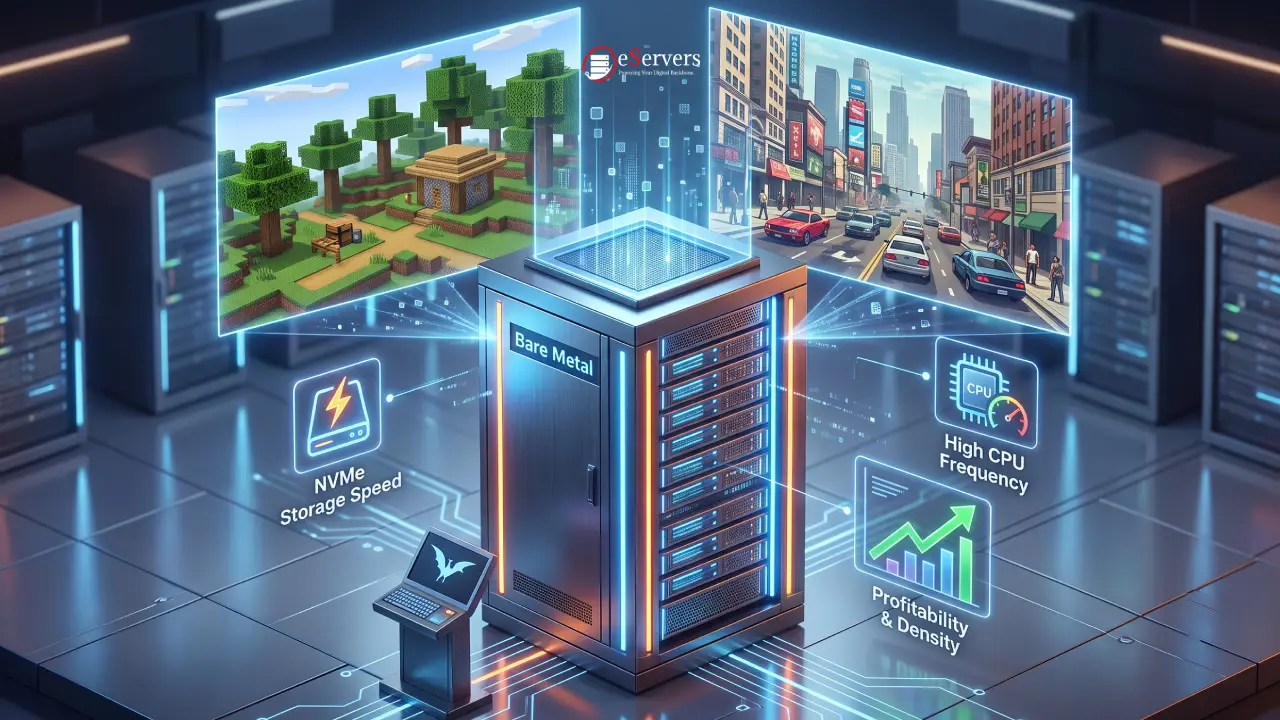
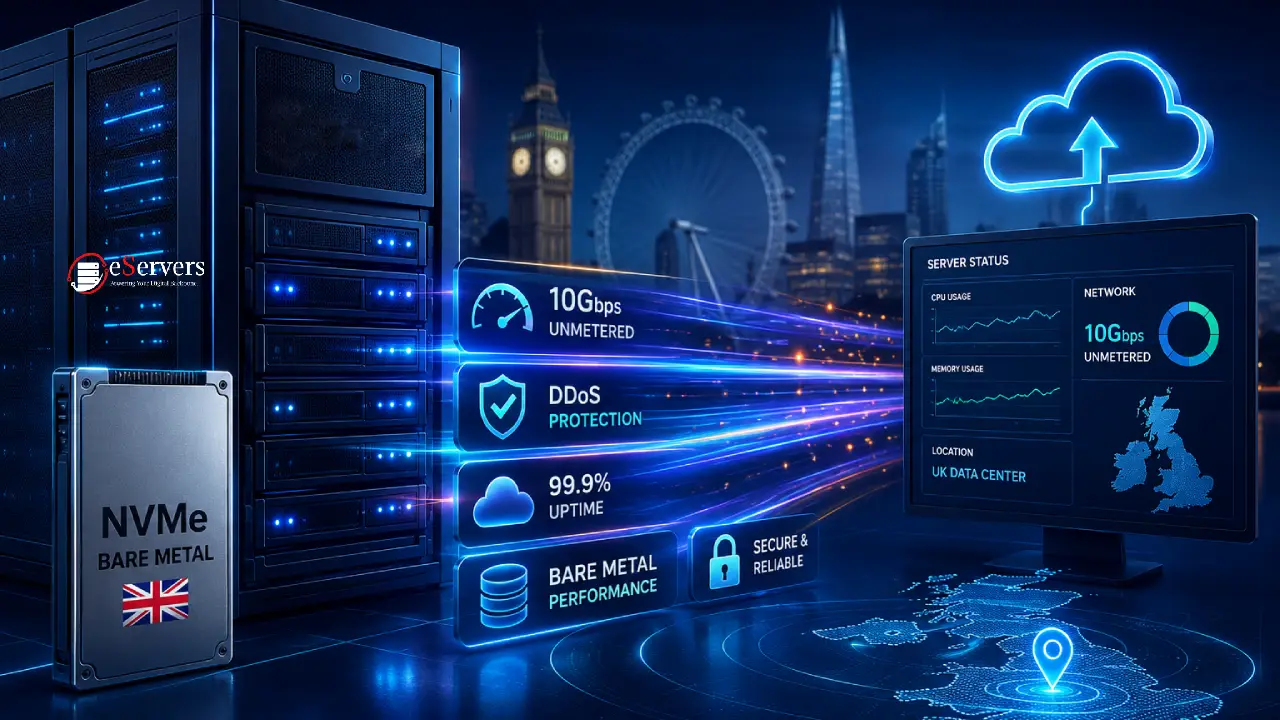
Bare metal hosting provides a physical server dedicated entirely to one customer, without a virtualisation layer between the hardware and the workload. A typical bare metal game server includes dedicated CPU cores, dedicated RAM, high-performance NVMe storage, dedicated network capacity, and full operating system control — giving the operator predictable performance and the ability to optimise every component around the specific workload.
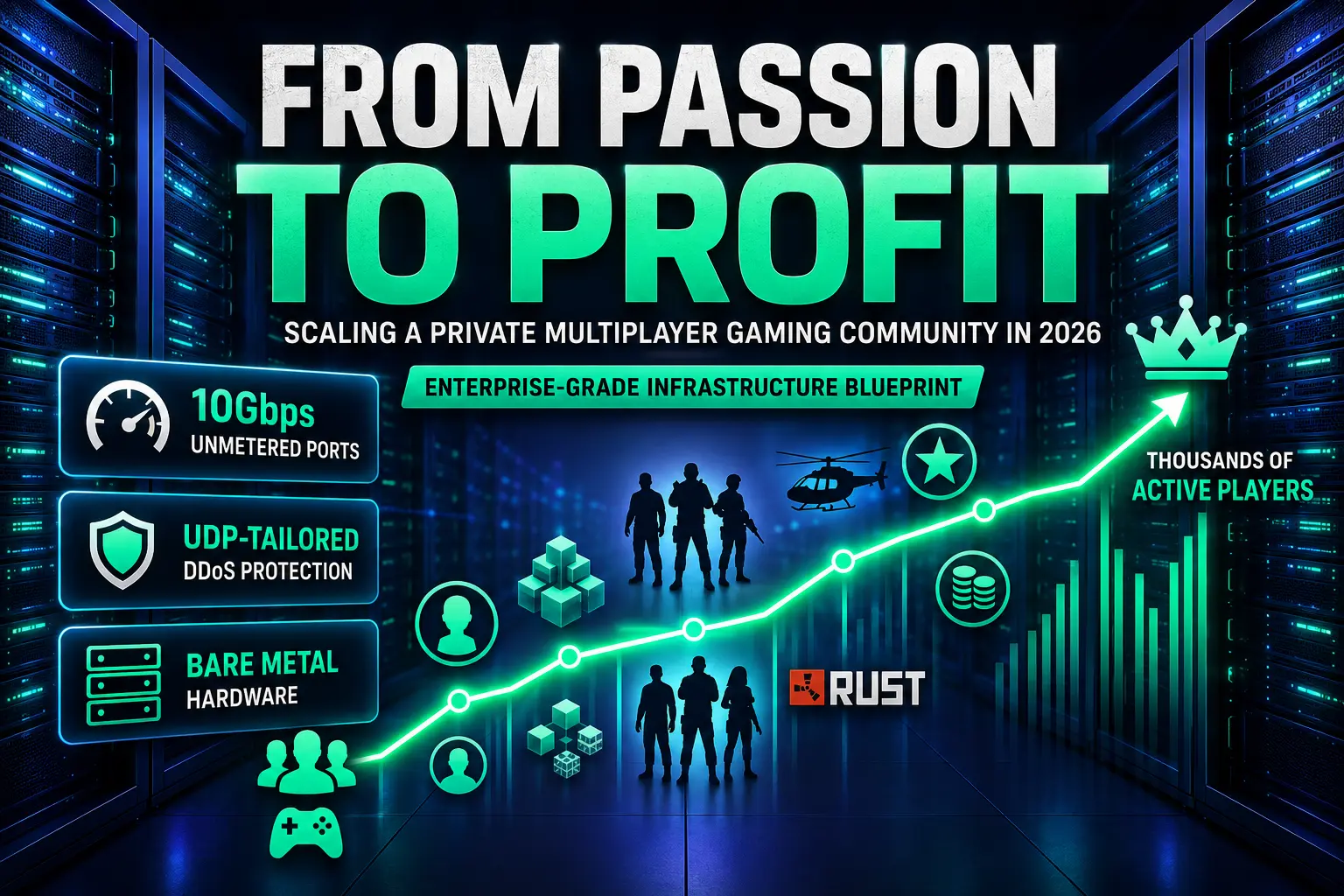
This makes bare metal particularly suited to Minecraft networks, FiveM communities, Rust servers, ARK servers, Counter-Strike 2 competitive infrastructure, and game hosting reseller businesses running many instances simultaneously.
The Economics Behind the Switch: Why Hosting Companies Choose Bare Metal
The decision to move to bare metal is rarely about performance alone — it's a density and margin calculation. On a VPS model, a hosting business pays a per-instance markup to the underlying cloud provider for every virtual machine it resells, and that markup persists indefinitely, scaling with every customer added.
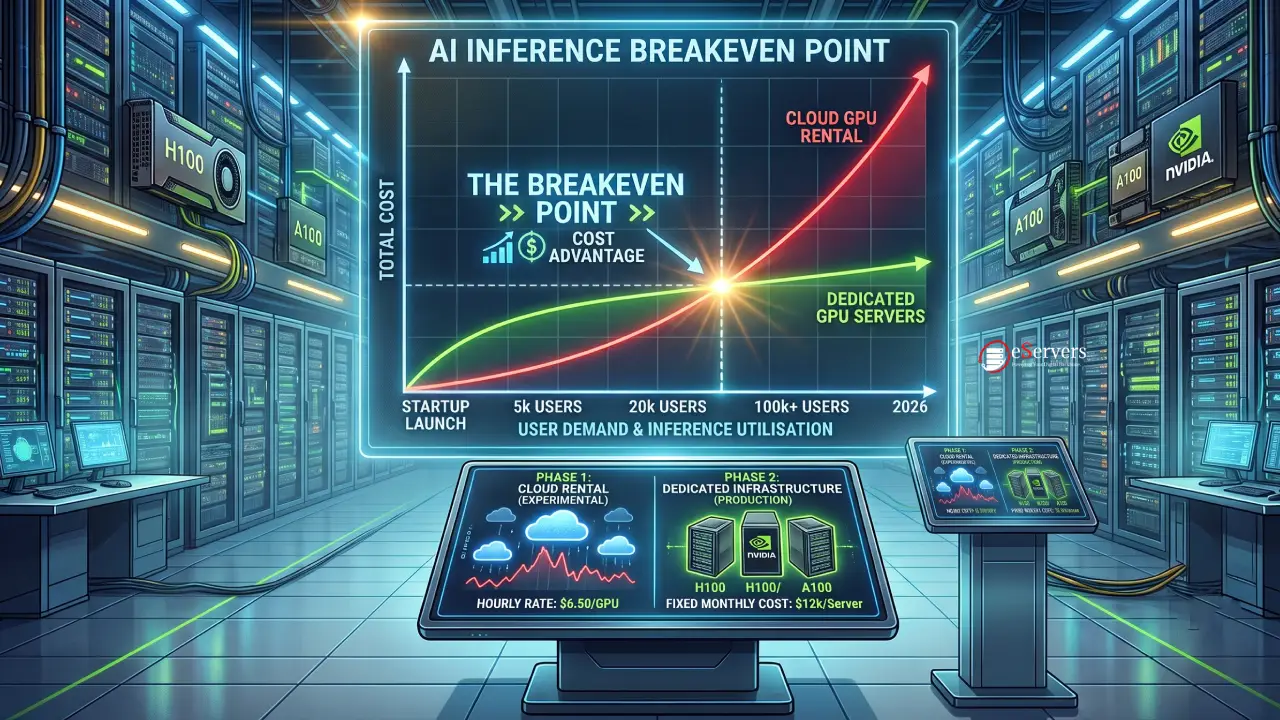
On bare metal, the cost structure changes: a hosting company pays for the physical server itself, then packs as many isolated game server instances onto it as the hardware can support. Past a certain customer density per node, the effective cost per game server slot on bare metal drops below the equivalent VPS cost, because there's no hypervisor markup being paid on top of every instance. This is precisely why panel-hosting resellers — businesses selling Minecraft, FiveM or Rust slots to end customers — see their margin structure improve as they move from a VPS-reseller model to an owned or leased bare-metal fleet.
The practical takeaway: bare metal rarely makes sense for a handful of low-traffic servers, but becomes financially compelling once a hosting business is running enough concurrent instances that a dedicated node's fixed cost is spread across many paying customers.
Why Game Servers Are Different From Normal Hosting
A normal website cares about page load time, database queries and request handling. A game server cares about CPU frequency, single-thread performance, memory latency, network stability, and consistent tick timing. A Minecraft server running on the vanilla Java server, PaperMC, Spigot, Fabric, or Forge depends heavily on CPU performance, because a large share of game calculations happen on the main server thread rather than spreading evenly across cores. This is why many game hosting companies prioritise high-frequency processors — AMD Ryzen, AMD EPYC, or Intel Xeon — depending on the specific workload.
RAM and Storage Requirements for Growing Networks
Memory needs scale with the number of concurrent game instances, plugins, world files, player data, databases, monitoring systems and control panels. Game hosting providers commonly deploy 64GB, 128GB, or 256GB+ RAM nodes depending on customer base, often using DDR5 ECC RAM for reliability on customer-facing workloads.
Storage performance directly affects world loading, server startup times, backups, and mod installation. Traditional HDD storage — and even many SATA SSD setups — struggle when dozens of game instances perform simultaneous operations. NVMe storage provides the throughput and low latency needed for faster deployments, quicker backups, and reduced loading delays across many servers on one node.
Network Performance: The Hidden Factor
A game server is fundamentally a communication system — every player constantly exchanges data with it. Low-latency routes, stable connectivity, sufficient bandwidth, DDoS protection, and quality upstream providers all matter. For UK-based gaming communities, server location genuinely affects experience: a server positioned closer to players across London, Birmingham, Manchester and the wider UK and Europe reduces latency in a way no amount of CPU or RAM can compensate for.
Pterodactyl: The Panel Behind Modern Bare-Metal Hosting
Pterodactyl is an open-source game server management panel that lets hosting providers deploy and manage many game servers from a central interface. It uses Docker containers to isolate individual instances while sharing underlying hardware efficiently, supporting Minecraft, FiveM, Rust, ARK, Terraria, and Counter-Strike communities with customer control panels, automated deployment, resource management and monitoring.
Running Pterodactyl on a limited VPS creates resource pressure once dozens of containers compete for the same virtualised slice of CPU. Running those same containers on dedicated bare-metal hardware gives full CPU availability, more predictable performance, and higher customer density — the combination behind most modern game hosting platforms: bare metal server → Linux → Docker → Pterodactyl → game servers → players.
FiveM Infrastructure: A Closer Look
FiveM roleplay communities place particularly heavy demands on server infrastructure. The core server process, FXServer, handles scripting, resource loading, and player synchronisation, while txAdmin provides the management layer hosting businesses and community owners use for monitoring, restarts, and resource control. OneSync, FiveM's player-scaling technology, allows servers to support significantly higher concurrent player counts than the platform's original architecture — but OneSync's higher player ceilings directly increase CPU and memory demand, and database load from framework scripts (ESX, QBCore, and similar) adds another layer of sustained resource pressure that a shared VPS environment struggles to absorb consistently during peak roleplay hours.
Signs a Hosting Business Is Ready for Bare Metal
Concurrent server count is high enough that VPS instances are consistently near full utilisation, not just occasionally busy.
Per-instance VPS costs have become a larger share of revenue than they were at launch.
Customers are reporting tick-rate stutter or lag during peak hours despite adequate VPS specs on paper.
The business already has, or can access, the operational capacity to manage physical or colocated hardware.
Infrastructure Considerations
Game hosting businesses moving to bare metal typically look at dedicated servers with high-frequency CPUs, NVMe dedicated servers for fast world loading and backups, and private networking between nodes for internal panel and database traffic. Larger reseller operations running Pterodactyl at scale often pair this with colocation for owned hardware, plus backup solutions for world and player data protection across the fleet.
Frequently Asked Questions (FAQ)
Is bare metal cheaper than VPS for game hosting at scale?
At high enough concurrent server counts, yes — the fixed cost of a dedicated node, spread across many game server instances via Pterodactyl, typically works out cheaper per slot than paying a VPS provider's per-instance markup on each one individually.
What is Pterodactyl and why does it matter for bare metal hosting?
Pterodactyl is an open-source panel that orchestrates many isolated game server instances as Docker containers on shared hardware. It's what makes bare-metal game hosting operationally practical at scale, rather than requiring manual server management for every instance.
Why does CPU clock speed matter more than core count for Minecraft and FiveM?
Both rely heavily on single-thread performance for core game logic, so a few very fast cores often outperform many slower ones — which is why hosts prioritise high-frequency AMD Ryzen or EPYC processors over simply maximising core count.
What is OneSync and why does it affect server requirements?
OneSync is FiveM's technology for scaling player counts beyond the platform's original limits. Higher player ceilings from OneSync directly increase CPU, memory and database demand, which is part of why growing FiveM communities often outgrow shared VPS hosting.
Does moving to bare metal mean losing scalability?
No — it changes the scaling model from vertical (resizing one VPS) to horizontal (adding more dedicated nodes), which is a different approach but not a less scalable one, especially at higher server counts.